
Everyone is heard in their own language.
People write and speak in the language they think in, and your doctors read it in theirs.

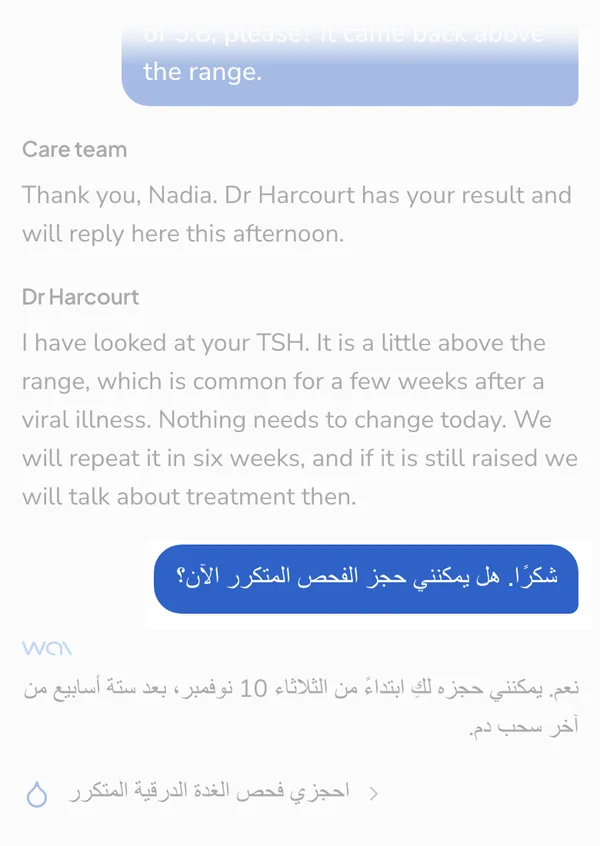
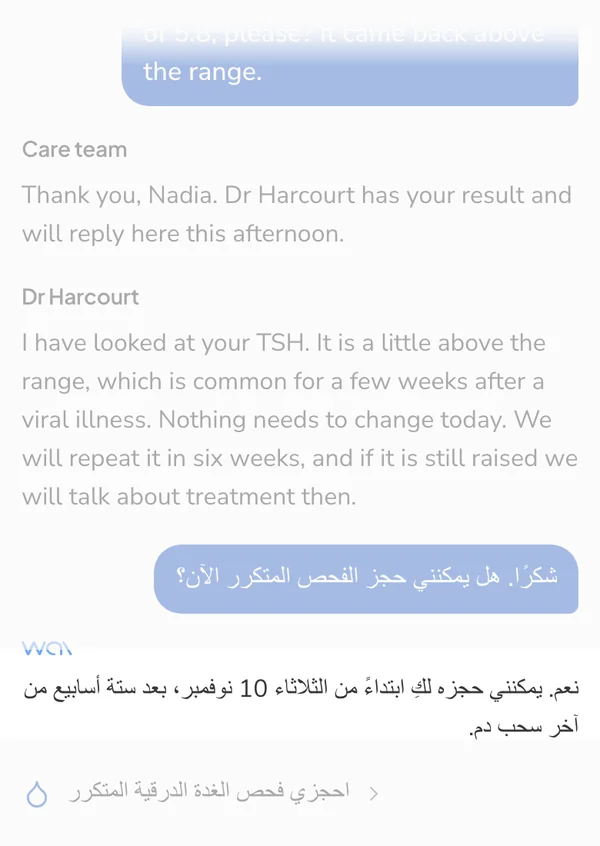
- Patients
- In their own language
- Doctors
- In theirs
- Arabic and Hebrew
- Right to left
- The original
- One tap away
The problem
Everyone understands their care in the language they think in
The owner
People fly in from Riyadh, Moscow and Lagos, and your front desk can speak with every one of them.
The doctor
You have a 10 minute conversation in any language.
The patient
They know exactly what the dose is.
How it works
3 steps, and your clinic decides each one
The patient speaks their language
Messages, voice notes and forms come in the patient's language, and the doctor reads them in theirs, with the original one tap away.
The doctor replies in theirs
The doctor writes in English, or their own language, and the patient reads the reply in theirs. Clinical terms use a glossary, and the doctor approves what goes out.
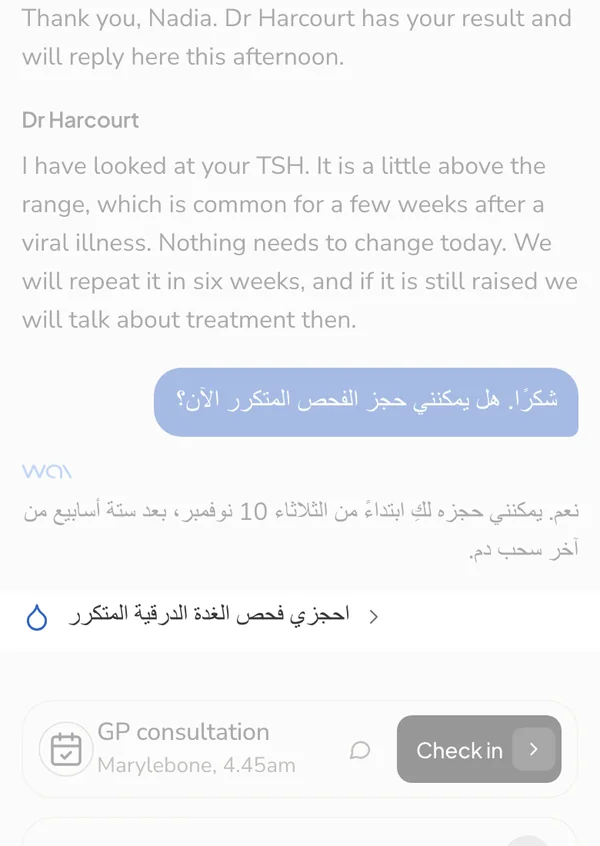
Everything else follows
Results, plans, letters and reminders reach the patient in the same language, and right-to-left scripts read the right way round.
See it on your own patients and your own doctors, in 30 minutes on video.
What changes
International patients understand their care as well as anyone else in the clinic
For patients
Understood, and understanding
The dose, the warning signs and the next step, in the language they think in.
For doctors
Complete clarity
Read every message in your language with the original beside it, and reply as you would to anyone.
For the clinic
A clinic for the world
Patients who travel to you get care they can follow, and they tell the people at home.
Over 90%
accuracy for Spanish and Chinese when a language model translated patient instructions, with at most 1% potentially harmful errors.
BMJ Quality and Safety. A published study, independent of Wai.
Where it works
The same product in every market, on each market's rules
United Kingdom
The doctor approves every translated clinical message. Where a consent or a complex conversation needs one, book a professional interpreter as you would today.
Part of the clinic's Wai plan.
United States
Section 1557 asks covered clinics to provide language access, and translated messages and plans help meet it alongside qualified interpreters.
Part of the clinic's Wai plan.
United Arab Emirates
Arabic and English are expected throughout, written right to left where the patient reads Arabic.
Part of the clinic's Wai plan.
Elsewhere
The clinic chooses its languages, and the glossary keeps clinical terms consistent in each.
Part of the clinic's Wai plan.
Records are hosted in each clinic's own country under its rules. Every credential we hold is listed with its status and date on our security page.
Which languages are supported?
The major languages your patients speak, including Arabic, Spanish, Mandarin, Russian, French and Hindi. Tell us yours and we will show you them in a demo.
Does the doctor see what the patient actually wrote?
Yes. The original is always one tap away, beside the translation.
Does it replace a professional interpreter?
No. For consent and for complex or sensitive conversations, a professional interpreter is still right, and the record notes who interpreted.
Can live calls be translated?
Yes. A call can be translated as it happens, and the note is written in the doctor's language.
Do results and plans arrive translated too?
Yes. Results, plans, letters and reminders follow the patient's language.
Partner with us
Build it with us, in your clinic
We set each feature up with your doctors, your prices and your rules, and the clinics that partner with us early shape what it becomes.
Or write to team@wellnessa-i.com. We reply within one working day.
